▶
Summary
Clients see the finished stone, but not every choice made along the way. In the Yunfu workshop, Mr Villa Stone walks through Hanbaiyu white marble balustrade panels for a bridge: very white, with a soft sheen and a translucent look — and the piles of cut material left out to get there. Yield on this job came in well below expectations. Some veins look like cracks but are smooth to the touch; real cracks are cut around, and crack-like veins are avoided too, because a panel shows five faces plus its cutouts. The hard part is not how to cut but where not to cut, and natural stone changes layer by layer, so judgments are made as the block is opened.
Chapters
Click to seek in the on-page player (after YouTube ID is set).
Full transcript
Clients see the finished result.
What they don't see is how many choices
and trade-offs we made along the way.
Let me show you
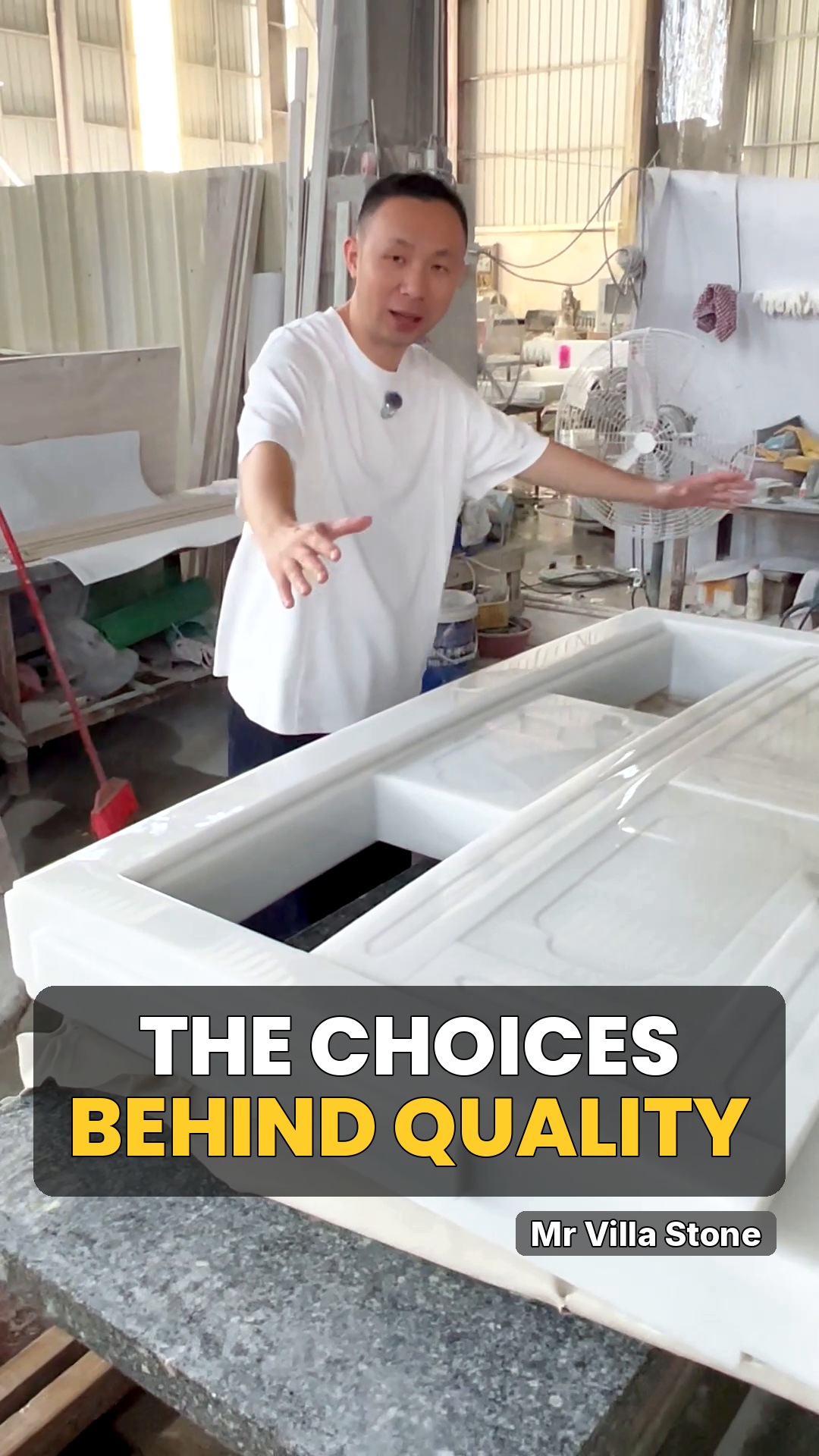
these balustrade panels for a bridge.
They're made from Hanbaiyu white marble.
Look at the texture: very white,
with a soft sheen and a translucent look.
These are the finished pieces we'll deliver.
But do you know what it took
to get that result?
That's the part the client doesn't see.
Come and have a look.
Let's see how we cut this block,
and what happened along the way.
This is the Hanbaiyu block
those finished panels came from.
To get that quality,
look at what we had to leave out.
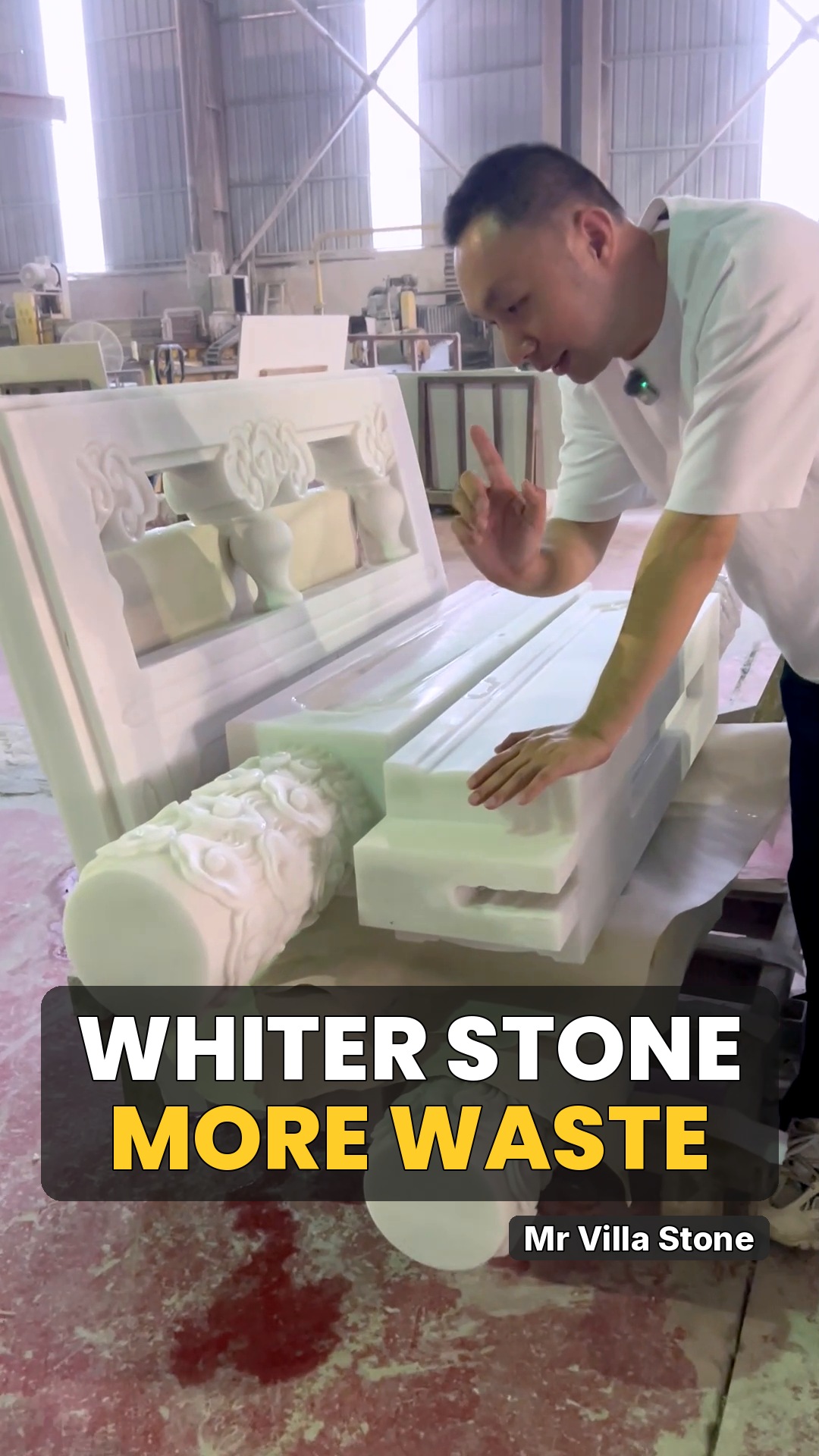
Here is the cut material we left out.
This section here, and here.
That pile, this pile, and this pile too.
This pile. This pile too.
And this one here.
Then these piles over here.
Two piles here. More over here.
And this pile too.
All these pieces had to be left out of the job.
Yield on this project was far below
what we'd expected.
That's a risk we couldn't predict.
Let me show you what I mean.
This slab has a lovely texture,
but there's a small issue.
This vein looks like a crack, but isn't.
The surface feels smooth.
Here, though, you can feel a crack.
We definitely cut around that,
and also try to avoid the crack-like veins.
These panels aren't like flat slabs,
where you mainly see one face.
A panel has six sides.
The underside is hidden against the ground,
leaving five visible sides.
The cutouts create even more visible surfaces.
We try to avoid those veins
as much as possible.
That's why so much material is left out.
Look at this piece.
We left it out because of that small vein.
Now look at the material below.
There's a little veining here too,
and you can't predict it in advance.
This is stone fabrication.
People think it's just cutting stone into shape.
The hard part isn't how to cut.
It's deciding where not to cut,
and which parts to avoid.
That's the hardest judgment throughout fabrication.
Working with stone means
dealing with uncertainty.
All this material we left out
wasn't something we could predict at the start.
Stone varies layer by layer.
This layer is fine and looks beautiful.
The layer underneath is fine too.
But in between,
there's a vein that looks like a crack.
Here we're cutting sections
twenty-five centimeters thick.
One layer is fine; another has a problem.
It isn't a fixed industrial process.
The outcome isn't certain.
We make judgments as we cut,
and that takes a lot of time.
A follower once asked me
how stone fabrication is priced.
This example helps explain it.
Suppose we were cutting uniform sintered slabs.
A few cuts on the machine and you're done.
That's quick.
But natural stone is different.
Every slab is natural, and every slab varies.
We have to cut according to those variations.
Those decisions affect the final result.
That's something the client doesn't notice.
Take all this material here:
they don't know it's been left out.
These are choices we've made
to achieve the result.
Sometimes, you just feel helpless.
We take on a project hoping to make money.
But on a job like this, we lose money instead.
That's the risk of working stone,
and the cost of a good finished piece.
That's how it is.
Meeting certain standards means
making these trade-offs along the way.
But clients don't know about those choices.