▶
Summary
Buying slabs for someone else to fabricate is not the same as working with a factory that plans layout, fabricates finished pieces, packs and ships. Mr Villa Stone compares cut planning and yield, vein fine-tuning during fabrication, specialty moldings and joints, and why packing for shipment matters. Site coordination notes are content sharing — our service focus is fabrication to drawings, packing and shipping; special requests can be discussed on WhatsApp.
Chapters
Click to seek in the on-page player (after YouTube ID is set).
Full transcript
Buy slabs and get them fabricated?
Or a turnkey delivery factory?
What's the difference?
Let's break it down.
First: buy slabs, then fabricate.
Say you see this material here—
you like it, you're happy,
you buy it. Take this slab as an example.
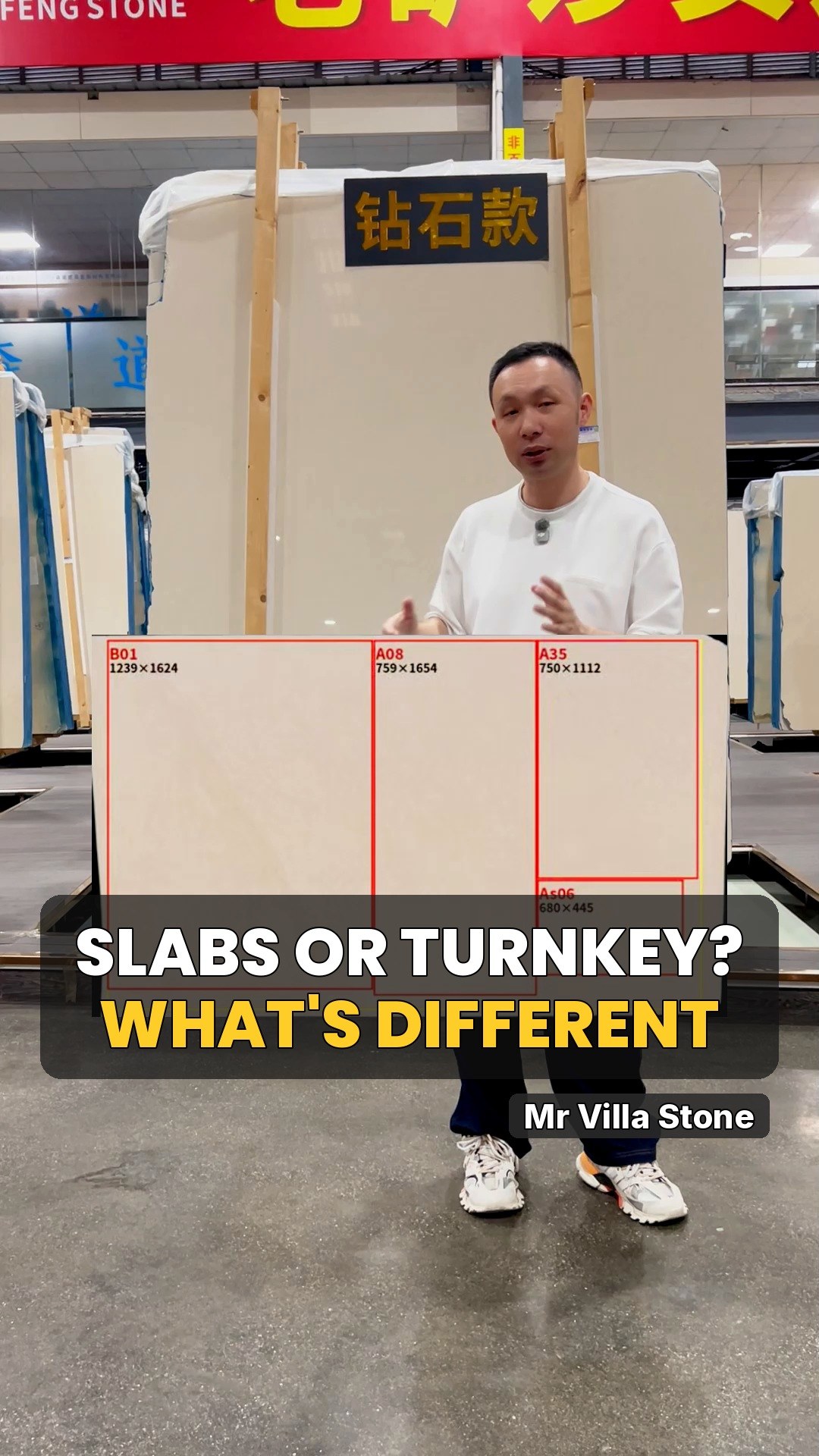
This slab is, say, 2.4 meters by 1.97 meters.
This slab goes into your home.
Say it's for flooring—your living room is 10 meters by 6.
What sizes should this slab be cut into?
High yield, and it looks good.
That part needs the fabrication shop to plan.
Because once the slab's sold,
their job is done.
otherwise you figure out yourself how to cut it.
That's a fairly specialized field.
What's involved?
The look, and the yield.
That's the first point. Second, during fabrication,
we fine-tune based on how the slab changes.
What do I mean? Natural marble—
it varies. The veining, say, has a bit of color transition here.
The face looks like this, but inward the veining shifts.
It might open wider, or tighten.
So here you need to fine-tune.
Does this cut piece fit better here,
or look more harmonious in another area?
Owners don't know this; the installer may miss it too.
So it's down to experience.
Third, how turnkey factories differ.
Factories each have their specialty.
It's like restaurants—
some only cook Hunan,
some only do Cantonese.
A Cantonese kitchen can cook Hunan,
right? But whether the taste is authentic,
whether it's good—that's another matter.
Some factories specialize in craftwork.
Our factory specializes in French style.
What we do most is moldings,
shapes, columns. These demand very tight joints where shapes meet.
Take this column joint.
Because when we polish,
a molding is joined and polished together.
So the fit has to be very precise.
Also, transport matters a lot.
We've taken losses on this before.
If one molding arrives broken,
it's a hassle. Replacing isn't hard,
but if it's a molding,
the polishing at both joints is already done—you can't haul those two pieces back to the factory.
So transport is very particular.
You have to do the packing and protection well.
Then the next step—
that's delivery and installation.
Installation is critical here.
I've seen good stone installed badly.
Before we had our own install crew, we used other guys.
They'd make simple, basic mistakes.
For example, our drawings call for aligned seams.
Border meets baseboard,
baseboard lines up with the wall.
But that guy goes by experience—
he ignores drawings and slaps the baseboard
Then when he does the wall panels,
oops, seams don't line up.
We paid.
Workers won't compensate you for that.
So every crew works differently.
So we set our standards.
How seams should align,
how wide the seam should be,
dry-hung or spot-fixed installation, what brackets to use behind,
what dry-hang adhesive—
we set all of it. Some factories lack turnkey experience,
They can do it, like I said,
maybe they usually cook Hunan,
and suddenly you want Cantonese,
give them a French-style villa.
They can do it. It just tastes different.
Many details won't be right.
That's the difference. These details and standards—
you can hardly feel them through videos or photos. So my advice to clients—
go see it yourself,
touch it, compare. At the factory, check the molding work,
then visit completed factory projects, the details—
the texture, the joints—are they done right?
What I've covered is just the tip of the iceberg.
In practice there are many more tedious details.
Like coordinating with other trades,
how to measure, how to order,
how to schedule. Very tedious,
lots of details. We won't go into it in this video.
That's it. See you next time.